
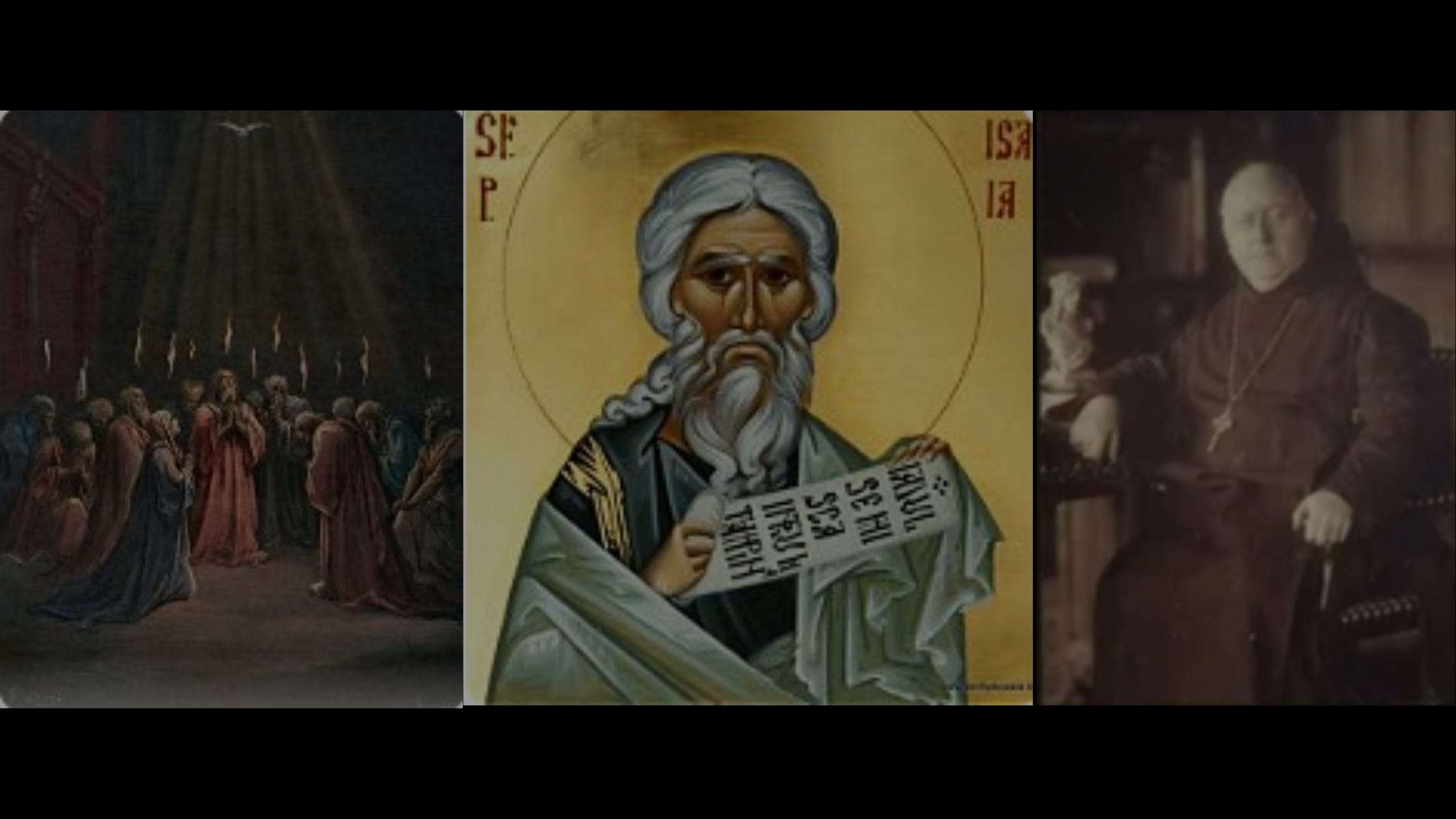
The Previous Parts

From This Book By Blessed Columba Marmion: Click Book Cover Image To Get A Copy

“Let us now say a word on each of the seven gifts. This number does not constitute a limit, for the action of God is infinite. We shall simply follow the order indicated by Isaias in his messianic prophecy without seeking to establish a gradation or any carefully marked characteristic in the relations between the gifts; we will try to say, as far as we can what belongs to each of them.
The first mentioned is that of wisdom: What does wisdom here signify? It is a sapida cognitio rerum spiritualium, a supernatural gift whereby to know or esteem Divine things by the spiritual taste with which the Holy Spirit inspires us. It is an intimate, a deep knowledge that relishes the things of God. We ask for it in the collect for the feast of Pentecost itself: Da nobis in eadem Spiritu recta sapere. Sapere is to have not only the knowledge, but the relish for celestial and supernatural things; it is not-far from it-what is called sensible devotion, but a spiritual experience of what is Divine, that the Holy Spirit wills to produce within us.
It is the response to the Gustate et videte quoniam suavis est Dominus. “O taste and see that the Lord is sweet.” This gift makes us prefer, without any hesitation, the blessedness of God’s service to all earthly joys; it is this gift which causes the soul to say: “How lovely are Thy tabernacles, O Lord!. . .better is one day in Thy courts above thousands of years away from Thee!” But to experience this, we must carefully put away all that draws us towards the unlawful pleasures of the senses.
The gift of understanding: makes us search deeply into the truths of faith. St. Paul tells us that “God hath revealed them by His Spirit, for the Spirit searcheth all things, yea, the deep things of God”. Not that this gift diminishes the incomprehensibility of the mysteries or does away with faith; but it goes further into the mystery than they simple acquiescence of faith; it bears upon the appropriateness or the greatness of the mysteries, upon their relations with each other or with our supernatural life. It has also for its object, the truths contained in the Sacred Books, and it is this gift which seems to have been granted in a special measure to those in the Church who have shone by the depth of their doctrine, those whom we call “Doctors of the Church”: but every baptised soul possesses within itself this precious gift. You read a text of Holy Scripture; you have read and re-read it many times without having been struck by it; but, one day, a sudden light flashes, illuminating to its depth, so to speak, the truth set forth in this text; this truth then becomes altogether clear to you and often a principal of supernatural life and action. Is it by your reflections that you have arrived at this result? No, it is an illumination, and intuition of the Holy Spirit Who by the gift of understanding, makes you penetrate further into the inmost and deep meaning of the revealed truths so that you may hold them the more firmly.
By the gift of counsel: the Holy Spirit responds to this prayer of the soul: “Lord, what wilt Thou have me to do!” He keeps us from all precipitation, from all levity, but, above all, from all presumption, so dangerous in spiritual ways. A soul that only wishes to be guided by herself, who worships her own personality, acts without consulting God in prayer. She practically acts as if God was not for her the heavenly Father from Whom every light comes: OMNE donum perfectum desursum est, descendens a Patre luminum. Consider our Divine Savior. He says, the Son, that is to say Himself, does nothing “but what He sees the Father doing”. The soul of Jesus contemplated the Father beholding in Him the model of His works; it was the Spirit of Counsel that showed Him the desires of the Father; that is why all that Our Lord did was pleasing to His Father. It is a disposition whereby the child of God is enabled to judge of things according to principles above those of human wisdom. Sometimes, natural prudence, always limited, points out how to act in such and such a way; then, by the gifts of counsel, the Holy Spirit shows higher principles of conduct which ought to direct the actions of the child of God.
It is not always enough for us to know God’s good pleasure.
Owing to our fallen nature, we often need strength to carry into effect what God requires of us; it is the Holy Spirit Who, by the gift of fortitude: sustains us in particularly difficult moments. There are pusillanimous (lack of courage, timid) souls that fear the trials of the inner life. It is impossible that these trials should be wanting; they are even so much the deeper in proportion as God calls us higher. But let us fear nothing: the Spirit of Fortitude is with us. Like the Apostles on the Day Of Pentecost, we shall be, by the Holy Spirit, endowed with power from on high, so as to accomplish the Divine will generously, to obey, like the disciples, God rather that men, if the choice be made; to support valiantly the adversities we meet with as we come nearer to God. That is why St. Paul prayed so earnestly for the faithful of Ephesus that God would grant them, “to be strengthened by His Spirit with might into the inward man”. The Holy Spirit says to such as he fills with fortitude, what God said to Moses when he shrank from the mission given to him of delivering the Hebrew people from the yoke of the Pharaohs: Ego ero tecum: Fear nothing, “I will be with thee.” Such a one is strong with the very strength of God. It is this strength that makes the martyrs and sustains the virgins. The world wonders to see them so courageous because it imagines they find their strength in themselves, while in reality they draw it from God alone.
The gift of knowledge: makes us see created things in a supernatural way as only a child of God can see them. There are many ways of considering what lies within us and around us. It is in a different manner that an unbeliever and one who believes in God contemplates creation. The unbeliever has only a purely natural knowledge, however wide and profound it may be; the child of God sees creation in the light of the Holy Spirit as the work of God wherein His eternal Perfections are reflected.
This gift makes us know created things, including ourselves, from God’s point of view; it makes us know our supernatural end and the means of arriving at it; but with intuition which preserve us from the false maxims of the world and the suggestions of the spirit of darkness.
The gift of piety: and of fear are complement of the one of the other. The gift of Piety is one of the most precious, because it concurs directly in regulating the attitude we ought to keep in our relation with God: the blending of adoration, respect and profound reverence inwards the Divine Majesty; of love, confidence, tenderness, perfect abandonment and holy liberty in presence of Him who is our Heavenly Father.
Far from excluding each other, these dispositions can be perfectly allied; but it is the Holy Spirit Who will teach us in what measure they are to be harmonized. In the same way, love and justice do not exclude one another in God. The gift of piety bears another fruit, it re-assures timid souls (there are such) who in dealing with God are afraid of not employing the right formulae in their prayers. This scruple is dispelled by the Holy Spirit when one listens to His inspiration. He is “the Spirit of Truth”.
If, says St. Paul, “we know not what we should pray for as we ought”, the Spirit is within us to help us; He prays in an ineffable manner which makes us cry towards God and be heard by Him.
Lastly, there is the gift of fear: It seems strange, does it not? to find, in the Prophecy of Isaias, this expression: Et replebis eum Spiritu timoris Domini, “He shall be filled with the Spirit of fear”. How can this be? How can Christ, the Son of God, be filled with the fear of God? It is because there are two kinds of fear of God: first there is the fear which thinks only of the chastisement due to sin, that is servile fear, wanting in nobility but not always without use.
Then there is fear which makes us avoid sin because it offends God: that is filial fear but it remains imperfect as long as the fear of punishment is mingled with it. It goes without saying that neither the imperfect fear nor servile fear had any place in Christ’s all-holy soul, there was only perfect, reverential fear, the fear that the angelic powers have before the infinite perfection of God; the fear that evninces itself by adoration and is altogether holy. If we could contemplate the Humanity of Jesus, we should see it prostrate in reverence before the Word to Whom His Humanity is United.
This is the reverence that the Spirit places within our souls; He keeps it there but in mingling it, by the gift of piety, with the love and filial tenderness which results from our Divine adoption and makes us cry to God: “Father!” This gift of piety implants in us, as in Jesus, the tendency to refer everything to our Father.
Such are the gifts of the Divine Spirit. They perfect the virtues by disposing us to act with a supernatural assistance which constitutes in us, as I have said, what is like a Divine instinct of heavenly things; by these gifts which the Holy Spirit Himself places within us to render us docile to His action, He achieves the work of making us more and more the children of God.
When therefore we let ourselves be guided by the promptings of this Spirit of love; when we are, in the measure of our weakness, constantly faithful to His holy inspirations-those inspirations that lead us towards God and what is pleasing to Him-the result is that we act in the full meaning of our Divine adoption; then our souls produce those fruits which are at once the term of the Holy Spirit’s action in us and, by their sweetness, are the like the anticipated reward of our fidelity to this action.
These fruits, as enumerated by St. Paul, are charity, Joy, peace, patience, benignity, goodness, longanimity(long‑suffering” or “patient), mildness, Faith, modesty, continence and chastity. These fruits, all worthy of the Spirit of Love and Holiness, are also worthy of our Heavenly Father Who finds His glory in them: finally, they are worthy of Christ Jesus Who merited them for us and to Whom the Holy Spirit unites us. The Holy Spirit Whom Christ, as the Word, sends us, is within us the principle, the source of those rivers of living water, of the grace which springs up within us into life everlasting, that is to say that makes us bear fruits of everlasting life. . . .Whilst awaiting the supreme beatitude, these waters “make joyful the city” of souls. St. Paul says too that all faithful souls, those who believe in Christ, have “in one Spirit. . .all been made to drink.” That is why the liturgy, the echo of this teaching of Jesus and of the Apostles, causes us to invoke the Holy Spirit Who is also the Spirit of Jesus as the “Living Spring.”
Closing Advertisement: Please Consider Helping Ordo Militaris Catholicus
Get Some Merchandise!

Ordo Militaris Catholicus, offers a wide array of merchandise items which helps them to do their non-profit activities when they need to help a group of persecuted Christians and it also helps them to pay the bills too.